Wednesday, April 11, 2012

Eggs and Spring

This winter was the worst that Ankara, as well as most of Europe, has experienced in the last ten years. From mid-January until late March, our world looked like this:


Most days had at least a little bit of snow cover, and fresh snow fell on us at least once a week. The world started to feel dark and heavy as collective Seasonal Affective Disorder set in.

Liturgically speaking, Lent could not come at a more perfect time. It is as the darkness of winter finally squeezes our optimism and melancholy rises to the front of our brains that we experience a little bit of humanity's dark wait for rebirth and Christ's coming. But what I love about Lent is that rather than forcing our hibernating souls to be unnaturally cheerful, Christianity encourages us to utilize the winter doldrums as a time to delve deep in to the dark corners of our souls, to the places we feel least comfortable. For it is when we examine those dark corners with their skeletons and monsters that we can reach a recognition of how in need we are of help. And just as we are in the darkest moment, of feeling like the snow will never melt, we'll never see the sun again, and we'll never be free of all these demons that haunt our pasts, Easter and spring come.

Warmth, sun, leaves growing on trees, a renewed sense of hope and optimism...Easter could not be more perfectly timed! For while we were still sinners (before the spring!) Christ died for us, and gave us another chance to start over and live without the burden of sin weighing us down. Spring and rebirth indeed!

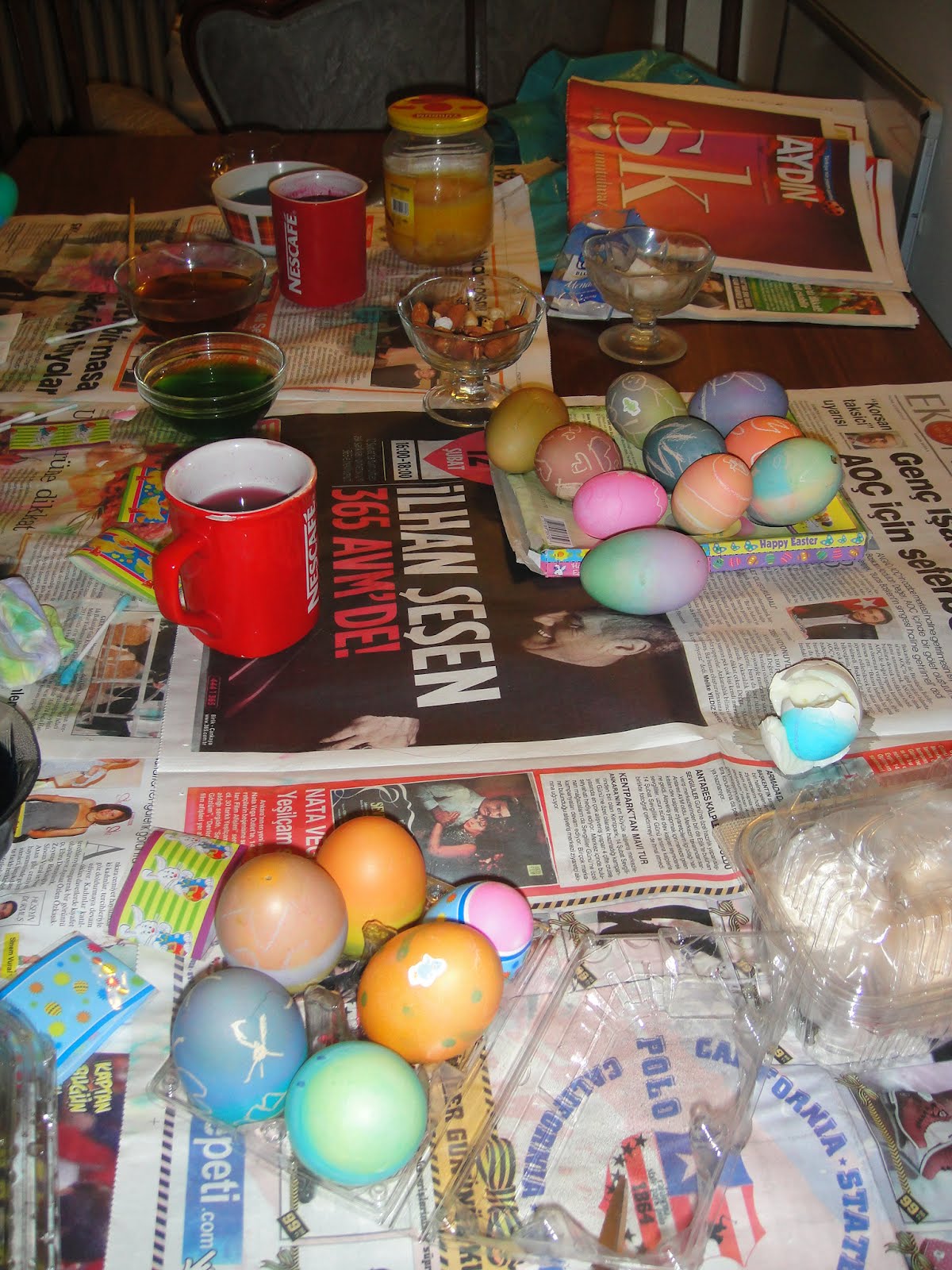
Last year, when my other American friends moved, they bequeathed me an Easter egg decorating kit, which has been lying forgotten in a corner of my kitchen for a good nine months. But last night we finally broke it out and I had the privilege of introducing my Turkish, Cuban, and Spanish friends to a new tradition- decorating Easter eggs!

Yes, I naively believed that Easter eggs were common throughout the Christian world, but the tradition seems to have skipped the Spanish-speaking areas of Christendom. When I invited a Turkish friend over to dye eggs, my Spanish and Cuban flatmates seemed just as fascinated by the idea as my Turkish friends.


I make no claims as to my artistic ability. There is, after all, a reason I leaned toward music rather than art in my studies. But my Cuban and Turkish friends took to the decorating immediately, and we spent close to three hours working on our eggs, with a good time had all around.


Yes indeed. Never underestimate how much fun a simple thing can be. These traditions are far from universal, and for those of us who have grown up with the same tradition, it's easy to forget how enjoyable or eye-opening it can be for someone who's never heard the story or painted the eggs before.

Happy Easter, everyone! And happy spring!

Friday, February 17, 2012

Unemployment games

Foreign teachers in Ankara have a few job options to choose from.

1. International/foreign schools. These are schools run by embassies, or private schools aimed at a demographic of expat kids. Curriculum is based on the standards of whatever country the school is associated with, and competition for jobs is pretty steep. The downside to teaching in these schools is that it's easy to get sucked into the expat community and then go through life in Turkey without really interacting with local people or culture.

2. English Medium Universities: Ankara has two universities, Bilkent and ODTU/METU, Middle Eastern Technical University, which teach all classes in English and employ native speakers in all departments. These schools also run a one-year preparatory school for students whose English scores aren't high enough to directly enter the university. These jobs are prestigious for foreign teachers, the salary is high, but the working conditions are difficult and there is a high turnover rate. Prep school jobs are ideal for recent college graduates, but you need at least a masters degree to get a job as a lecturer in the university itself.

3. Turkish Medium Universities: Most universities in Ankara have English language departments where English is taught as a foreign language. Most of the instructors are Turkish, but there are foreigners working there as well.

4. Private kolej/high school/primary school: A lot of schools want native speakers in the classroom to assist the Turkish teachers of English, but these jobs aren't as easy to find unless you know someone at the school. Many of these are part time jobs, and I've heard horror stories about discipline and student behavior.

5. Private language schools: This is what I've been doing here all along. Language schools are open to anyone who wants to learn English, and run classes whenever demand allows, usually evenings and weekends, with a few daytime classes. A lot of these are run illegally, and the foreign teachers have to hide in a closet when government inspectors come around. There's usually little job security, as this is the job of choice for the "backpacker" language teachers who come for a few months to a year, and employers know they can always find more teachers to replace those who leave. These are also operated on a business model, meaning profit outweighs education. Pay is decent, but most schools pay teachers on an hourly basis, meaning that you're at the mercy of the enrollment numbers.

6. Tutoring: Native speakers are always in demand, and it's not terribly difficult to pick up some private tutoring on the side of a normal job. However, it's not going to get you that all-important work visa, so doing it full-time isn't an option.


Some jobs, like the international schools, English universities, and some language schools, have extra perks like airfare to/from your home country and free housing. Others won't even provide a work permit, and you find that a lot of teachers are working illegally.

But legal or not, the fact is that in Turkey, demand for qualified native speakers is far greater than the supply, giving teachers the upper hand in contract negotiations. In fact, it's very possible for an American to walk into Turkey on a tourist visa and find a job within a week.

Knowing this, it was much less difficult than I anticipated to walk into my boss's office back in November and inform her that I didn't intend to come back after my trip to the United States. I had grown tired of fluctuating work hours which made my monthly income unpredictable. I was tired of working seven days a week, particularly Sunday mornings. Since my arrival in Turkey I had gone to church maybe three times, and after June attending weekly house meetings for Bible study and worship was no longer an option. I was spiritually exhausted, mentally stressed, and frustrated with the job.

But all the same, hopping on a plane back to Turkey in December with not the slightest whiff of a job wasn't as crazy as it sounded. For a month I held on to my pride and started hunting jobs at universities while living off the few liras I made from tutoring. The prospects seemed good at first: I had two universities interested in me, but one rejected me after the dean decided I was too young to be a teacher. I continued to hold out for the other university, but by the end of January, my savings dried up from two trips to the USA and my wallet forcing me into a poverty diet, I realized that the time had come.

I didn't want to resort to the language schools again, now that I was rediscovering the social possibilities of free weekends and evenings, but I didn't have much of a choice. But like I said, they're desperate, and after perusing the internet, I sent an email to the school I thought would offer the best salary and benefits, and they called me for a job interview the next morning. I started teaching last week, back to the weekend lessons, but at least I was able to finagle more morning and less evening work. It does feel nice to get up in the morning and go to work, rather than sit around the house all day with no reason to brave the icy sidewalks.

So it wasn't the ideal solution, but the grand experiment wasn't a failure. The month of unemployment gave me time to do a lot of reading and spend some time with friends. I also was able to visit a local church a few times, where I got connected to some other expats who invited me to join a choir, so I'm doing something musical again for the first time since I got here. And having a musical activity to look forward to, even once a week, makes me feel more alive.

As for the job, it's a step up from where I was before, if not where I really want to be. Life is uncertain, with no path for the future, but at least today and tomorrow are taken care of. And for now, I am praying for enough strength to be content with that until a next step is possible.

Friday, January 27, 2012

Snow Bus

If there is one thing that that I have learned during my time in Turkey, it is that Turkish people are intelligent, generous, hardworking, and brilliant in many ways. However, driving in the snow is one area I cannot count among their strengths. Ever since our most recent snow-laden cold snap swept in from Siberia, our street has echoed with an eternal chorus of tires spinning fruitlessly and engines screaming, "I think I can, I think I can!" as they battle the hill in front of my house. This is often followed with petulant drivers leaning on their car horns further down the hill, as if the stuck driver were blocking up the street out of spite.

It's an ongoing battle. Some drivers put chains on their tires for extra traction. Other idiots go joyriding in the middle of the street, building up speed and then hitting the brakes to send the car spinning. Most just hunker down and pray that they reach their destination alive.

I was stir-crazy enough from several days stuck at home in the snow to ignore the horrible driving conditions today and escape to a mall with some friends. Yes, laugh all you want at our teenage-ness; there isn't much else to do in this city on a cold afternoon. But the mall is far enough away that I had to take a bus to get there.

Wrong day to do such a thing! Getting there was fine, but I hit rush hour on the way back. I hopped on a bus in the center of town that was so sardine-packed I barely squeezed in, and spent the ride crushed up against the door, falling off every time it opened. Once I ended up pressed in a position with my left arm twisted behind my back, my rib cage contorted so that I couldn't breathe, and one foot hovering in space as I teetered on a stair. I tried pushing myself up onto the step next to a very large woman who glared at me for violating her personal space, but at that moment the door opened at the woman said, "I'm getting off here!" and pushed me back down the stair, off the bus, and into the snow.

But our poor bus driver was facing an obstacle course of his own, even more intense than Ankara rush hour on a normal day. Not once, but twice, he was forced to find a different route because someone had decided to abandon their car halfway up a hill on a major street. The first time this happened, the bus driver promptly shifted gears and drove backward down the hill for probably 200 feet to the previous intersection. A general rebellion rose up among the passengers when they noticed that we were now off-course, and several people got off the bus and insisted they'd find taxis instead. I thought this a silly idea, seeing as there were no taxis anywhere to be seen, but of course I'm a foreigner so my perception is often misguided.

The rest of the passengers were stoic, holding to the Muslim culture of fatalism and acceptance of the cards that God deals us in life without complaint. There were even smiles and bets of how long it would take us to get back to where we needed to be. It seemed a simple matter of zig-zagging a block around, except that we were impeded again at the next turn, where another car sat parked in the middle of the intersection, hazard lights warning us that no one was inside to move it from our path. The bus driver tried to get around him, but of course buses make wide turns and it was simply impossible. Being smushed in the front corner of the bus, I had the best view of how very few centimeters stood between me and the side of this car. We were not making this turn. At this point a guy hopped off the bus to direct the driver as he maneuvered back and forth and around, finally managing to round the corner. But victory was short again because 100 feet ahead a school bus was stopped in the middle of the street.

No fear! The bus driver, his friend, and about five other guys decided this was the perfect time to attach snow chains to the tires, so they all jumped off and two guys applied the chains while the others smoked cigarettes and watched. They jumped back on shortly, with gleams of NASCAR pit crew pride in their eyes as they congratulated each other on accomplishing this in under two minutes.

By now, we were completely off-course and I gave up all hope of any plans but going home to a hot shower, dry clothes, and a bowl of soup. The bus trekked uphill more steadily with the chains, but since the traffic had us stopping every ten seconds it was mostly irrelevant. Twenty minutes later we were finally back on a road I recognized, and the rest of the passengers began to relax a little more. I decided to bail on the bus and walk forty minutes home, figuring it would be faster and more comfortable than being stuck in traffic crammed into a space significantly smaller than what I normally occupy.

This was the right choice, despite the cold and wet. Streets everywhere were closed off due to accidents, cars were slip-sliding everywhere, and the city was generally a mess. So, the lesson learned today is that snowy days in Ankara are meant to be enjoyed from inside, where I can simply laugh at the poor automobile owners in their futile attempts to scale hills instead of falling victim to their folly.

Let it snow, let it snow, let it snow!

Wednesday, January 25, 2012

Sledding

Traffic and social life tend to come to a halt whenever it snows in Ankara. There is no municipal snowplow system, so it's up to determined citizens to clear paths through the streets and open up the roadways again. But until that time, buses and taxis alike find their paths impeded, and pedestrians like me tire quickly of arriving places soaked to the knee and splattered with blackened slush.


The past two weeks of intermittent snow have left the streets resembling what an optimist might describe as a rich chocolate cake dusted with coconut, and what I might call a disgusting sludge that does no good for my shoes.

Yesterday the snow started again mid-afternoon, and fell steadily all night. Around 11 pm my flatmate suggested we go out for a walk to enjoy the winter wonderland while it was still fresh. So we bundled up and went out to explore the neighborhood. (Photo credits to my flatmate. I was too busy slipping and sliding to take pictures.)

The odd thing is that we were far from the only street prowlers out. The local park was crowded at midnight with camera-wielding families, couples with dogs, and sledders. To be clear, only about five people in Ankara own actual sleds. But as I've mentioned before, there is no flat space in the whole city, which means that a blanket of snowfall creates a sledders' fantasy land of abundant slopes. The temptation is great enough that a mass improvisation occurs, with the population rushing to their kitchens to fetch spare plastic bags, which are surprisingly slick little sleds.

My Cuban flatmate, being from a tropical island, had never gone sledding in her life, and was equal parts curious and terrified of the activity. Her fear was amplified by the sight of Turkish college guys racing their plastic shopping bags down the steepest, longest hill in the park at maximum speed, surrounded by a laughing gang of about twenty friends who were drinking beer and cheering them on. Several of them ended their runs sprawled out in a snowbank after a final bump sent them flying.

Thankfully we had lots of options for a bunny slope, and managed to find a hill that wasn't too steep for her first adventure. She screamed the whole way down, but then immediately ran back up the hill to try it again. I'm sure in time she'll be up on the big hills with the Turkish guys, skidding gleefully into piles of kicked-up snow.

And for the rest of the time, I am making full use of the armchairs which sit in front of the large front window in our living room, reading classic novels, sipping hot tea, and watching the snowfall. Bliss, indeed.

Sunday, December 11, 2011

Which planet are we on?

If you're anything like me, there are certain Bible passages where your eyes glaze over a bit, such as interminable genealogies or records of ancient civilizations you never learned about in school. I also tend to ignore geographical names I don't recognize, so a lot of the New Testament reads something like, "And next Paul traveled to blah blah blah, passing by blah blah, blah blah, and the city of blah blah, where he met up with So-And-So, and then went to Blah Blah island."

Well, it turns out that "Blah Blah," in the New Testament, particularly in Acts and the epistles, is usually located in Turkey, which back in the day was the Roman province of Asia Minor and where a lot of early Christian missionary activity was located and some of the earliest Christian communities began to grow.

One of these exotic and meaningless names is Cappadocia, a region in south central Asia Minor mentioned twice in the Bible, first at Pentecost when Luke states that some residents of Cappadocia were treated to what must have looked like a flash mob when the Holy Spirit descended on the disciples; and again by Peter, who addressed his first letter in part to the Christians in Cappadocia.

So when my students started insisting that I put Cappadocia on the top of my list of travel destinations, the name registered as one of the Biblical "blah blahs" that I'd never paid much attention to. What I didn't realize is that St. Peter wrote a letter to hobbits. Because, you see, the people of Cappadocia, both in antiquity and to a certain extent today, live in houses like this:

0r this
which make up neighborhoods like this

and then cities like this
set against a landscape which stretches out like this for 250 miles east-west and 120 miles north-south, much of it looking like this.


Cappadocia's landscape is characterized by the bizarre rock formations created by a series of volcanic eruptions and erosion which left the area punctuated with tall towers known as "fairy chimneys."

Local people figured out as early as the Bronze Age that the soft volcanic rock was perfect for carving out cave dwellings that provided shelter from not only harsh natural elements, but also marauding enemies who were put off by the mountains. The ubiquitous fairy chimneys are great for hiding behind when your nemesis is trying to spot you from a lookout in the mountains. But the locals also had the advantage of a natural castle at the highest point in Cappadocia, just waiting for someone to carve a palace out of it.

Perhaps it isn't the Shire, but it's hard to walk through Cappadocia without imagining some sort of fantasy creatures as its residents. And yet, somehow the only Hollywood film to make use of this place is the upcoming "Ghost Rider 2"with Nicolas Cage, which is certain to disappoint in every way except its filming location.


It's no surprise that Cappadocia is always on the "must-see" list for travelers coming to Turkey. It's got something for everyone, whether you're into geology, history, delicious food, or simply climbing around on rocks. Or, for people like me who love all of those things, you might call it paradise. At any rate, next time I encounter 1 Peter, I will certainly have a mental image of hobbit Christians huddled together in a cave reading the words of St. Peter.

Shopping in Istanbul

Istanbul in the 1600s was probably the closest a shopaholic could get to paradise on earth. It was the seat of a major empire that encompassed regions stretching from Morocco to Hungary and over to western Iran, and which laid claim to all the treasures of those regions, and also situated perfectly between Europe and Asia, right along the path of every major trade route in the world, where merchants from all areas of the known world could gather in a central location to trade. And the grand Mecca of world shopping centers was the Grand Bazaar, a labyrinthine covered bazaar built in 1461 by Sultan Mehmet "The Conqueror", which today still boasts 58 streets with over 4,000 shops selling anything you could ever want to buy and more. Gold, silver, meerschaum pipes, antique paintings, hookahs, Turkish carpets, hooded sweatshirts, colorful scarves, scented olive oil soaps, wind-up toys, marble chess sets--there is no end to the variety of merchandise in this market.

The ability to haggle over the price of your purchases isn't the only thing separating this building from the Mall of America. As with anything else in Turkey, shopping is an intensely social experience, for the vendors as well as groups of shoppers. There are plenty of merchants hawking tourist goods near the front entrance, who are clearly interested in selling as much overpriced junk to foreigners as they possibly can, and the incessant shouts of "Hello friend! Yes please! Here! Bonjour! Where are you come from?" drive me absolutely crazy.

But if you can survive the initial wave of harassment, it's more than possible to sneak into some of the back corners, where you can meet shop owners whose lifestyle flies in the face of my American Protestant work ethic in a way that makes me wonder if efficiency and productivity are really worth the hype. To these people, business is not simply about liras and moving inventory off the shelf, but about hospitality and the opportunity they have to meet people from all over the world who come to this place.

In the bazaar, a visitor's eyes might pass over tiny shops on the corner where men load up trays with small glasses of tea to deliver to every shop in the market. But these tea distribution teams represent the heart and soul of the bazaar, the hot beverage without which Turkey would probably implode. An offer of tea is a gesture of friendship that signifies your worth to a vendor is more than the dollars you might give them.

The first time I visited Istanbul in September, I visited the Grand Bazaar more as a way to kill time while waiting for a friend than to accomplish any shopping. This is a far better place to hang out than a mall, because I think at least half of the three hours I spent within the vaulted walls of the bazaar was spent sitting in shops drinking tea and chatting with merchants who were more than happy to help a solitary traveler pass the time.

This visit proved to be similar in that I think we spent more time sitting and chatting than browsing through merchandise. My friend and I initially wandered into a carpet shop because he was hoping to pick up a handwoven kilim, but I don't think he could ever have anticipated that we would spend close to an hour and a half in this little store. The owner, while appreciating Chris's interest in his carpets, acted as if closing a sale was the last thing on his mind. He immediately sat us down in his shop, brought us tea, and talked our ears off about a wide variety of topics. Occasionally other customers would wander into the shop and he'd excuse himself to take care of them, or more often to call his assistant to take care of them. But it was clear that he was enjoying our company, and that his daily work life was as much about these moments as it was about the profits.

The same held true later in the afternoon when serendipity led us into a small, dimly lit art studio where every square inch of wall was covered by paintings and Arabic calligraphy. The artist himself sat in the back, hunched over a piece he was working on, but he did not seem in the least put out by an interruption, even when it was clear that we weren't looking to buy anything. He invited us to sit and join him for a few cups of tea as well, and he and Chris chatted about art and business while I helped the artist's assistant with his English homework. Later another friend of theirs wandered into the shop for no particular reason other than to hang out a bit, which also bothered nobody. The whole atmosphere was so relaxed and pleasant, with these men knowing that they earn their livings and therefore feeling free to enjoy their day instead of killing themselves over a few extra dollars. Our new friend even pulled out some scrap paper and wrote our names in calligraphy as a gift.

This is certainly not a typical Turkish shopping experience, as most of my forays into retail resemble American shopping so much that it's not worth blogging about. But I can get the sense that back in the day when markets were dominated by these small, family-owned enterprises, time for gossip and tea with friends was half the point of entering a shop. And the Turkish sense of hospitality shines strong here in the bazaar when merchants are given the opportunity to run their businesses in a way that allows them the flexibility to turn prospective customers into prospective friends.

Saturday, December 10, 2011

Treasures of Constantinople- The Hagia Sophia


When I tell people that I'm visiting Istanbul, nine out of ten Americans will respond with a brief pause and then some sort of reference to the city's former appellation bestowed upon it by the Emperor Constantine, and the fact that this name has since been changed. I will never cease to be amazed that at some point in the 20th century, a man named Jimmy Kennedy decided that given a catchy melody, the Ottomans' 1453 takeover and subsequent renaming of the Byzantine capital would make a great pop song, and that the song did indeed become popular enough that, fifty years after its composition, most Americans instinctively reference the song when they hear the name of the largest city in Turkey.


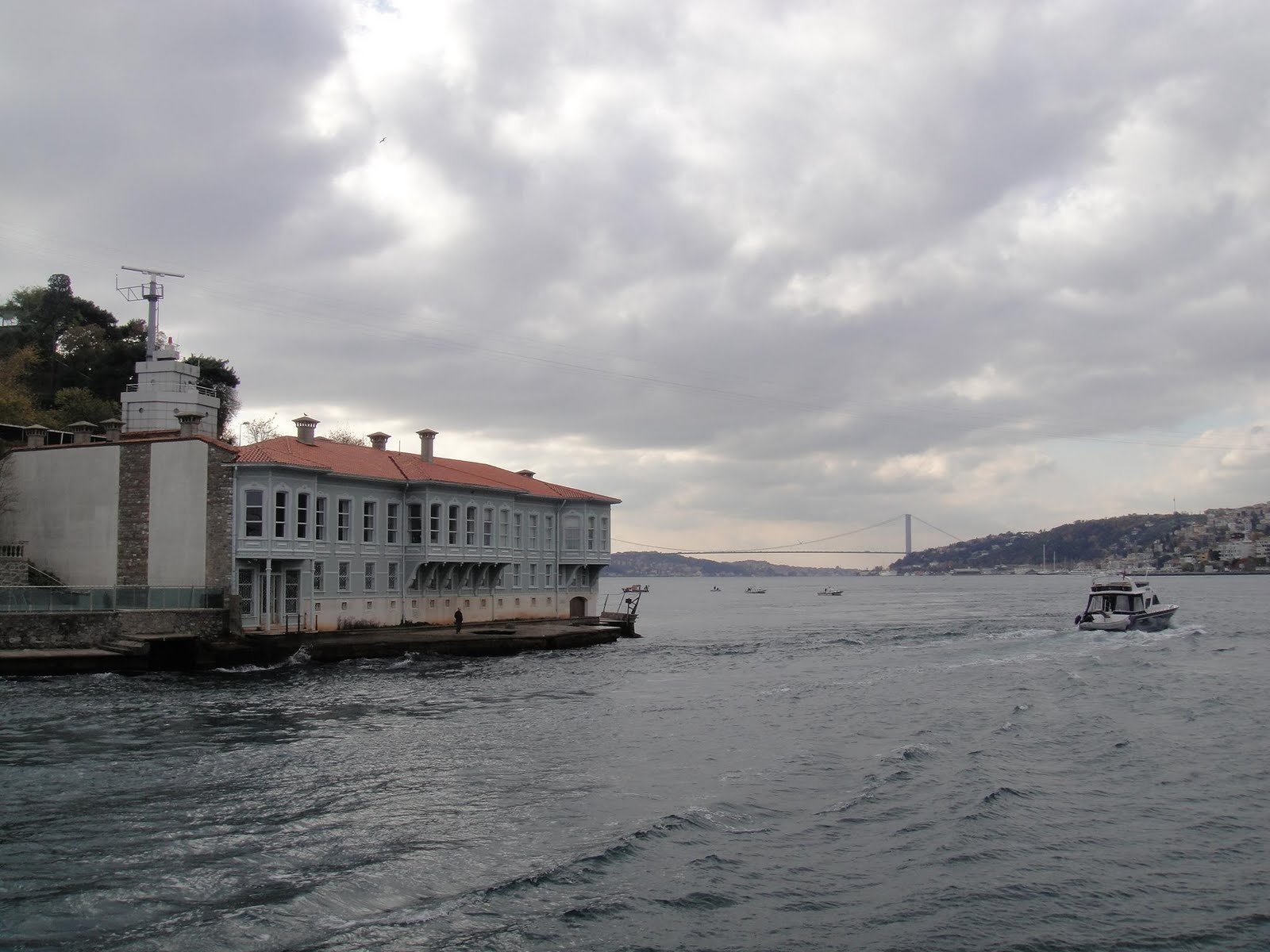
However, there is much, much more to this great city than They Might Be Giants could ever hope to capture in two minutes and thirty five seconds. Istanbul is truly an amazing city, occupying a unique place in both geography and history, sitting in a spot that, apologies to China, could be considered the center of the world. Istanbul straddles the Bosphorus Strait, which separates Europe from Asia, and is the only city in the world to sit on two continents. It is also the only city to have been the capital of two major empires, the Byzantine and Ottoman Empires. Between those two, it was a world seat of power for well over a millennium. Today it is one of the largest cities in Europe, a sprawling metropolis of over 18 million people that takes pride in its history and traditions, but still has an eye on the future and is definitely a hip place for artists and party animals.

The Bosphorus Strait- Asia on the left, Europe on the right, and the Sea of Marmara ahead


The old travel writer's cliche holds very true in Istanbul: you could spend a lifetime exploring this vibrant city and never be disappointed by the cultural wealth, both historical and modern, that you would upturn in the process. But in my recent journey to Istanbul, hosting a good friend from college who came to explore Turkey with me, we stuck to the major sights.


Probably any western tourist who ends up in Istanbul immediately heads to the same iconic location on the historic peninsula of Istanbul: the Hagia Sophia. And for good reason; it is not only one of the most beautiful buildings I've ever seen, but it's also one of the most historically significant.


The Hagia Sofia, or Ayasofya, was constructed by the Roman Emperor Justinian in 532 AD. The entire structure was built in five years, and was the largest church in the world for a thousand years until the Ottomans conquered Constantinople in 1453 and converted it into a mosque, at which point it became one of the largest mosques in the world. After World War I, when the Turkish Republic was established, there was some controversy over which faith held a better claim to the building, and in a move inspired by Solomon, Mustafa Kemal Ataturk determined that the Hagia Sophia would be better off as a museum for people of all religions to enjoy equally.

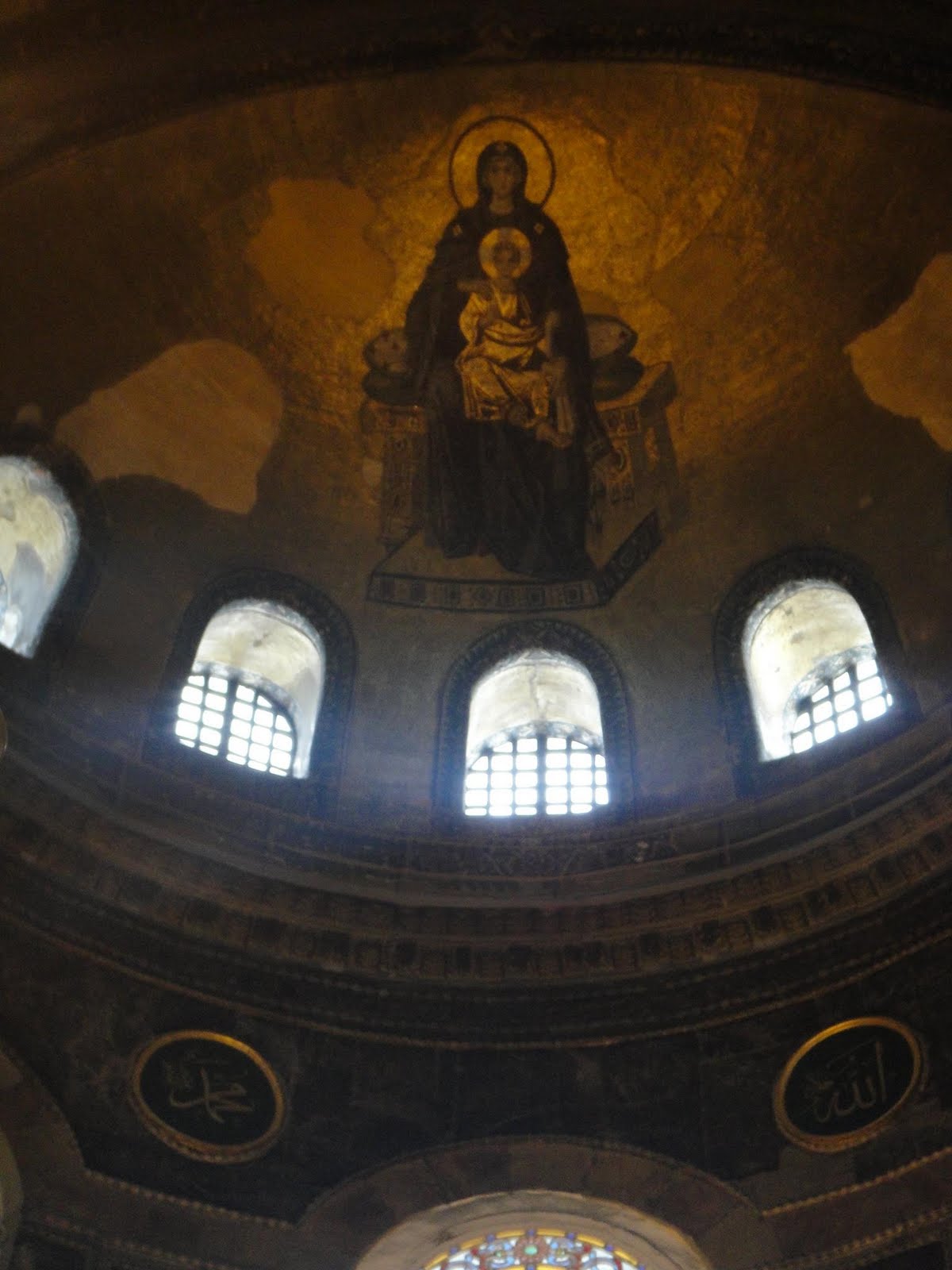
The jumbled history of the cathedral leads to such odd juxtapositions as this- the Arabic calligraphy on the bottom says "God" on the right, and "Muhammad" on the left, with Jesus and Mary hovering over them in the center


This dome was one of the largest in the world at the time, and utilized a lot of new architectural techniques that went on to influence later works. You can see the top is ringed with Arabic calligraphy done by the Ottomans, although the seraph paintings are clearly from the Byzantine era.


The Hagia Sophia is the pinnacle of Byzantine architecture, but because of its prominence, when the Ottoman Sultan decided to build his own mosque opposite the Hagia Sophia, his architect designed the new house of worship in a similar architectural style, which came to influence all mosque construction throughout Turkey.


Walking through the Hagia Sophia today, you encounter not only literal mosaics, some of the greatest in all of Byzantine history, but a figurative mosaic of history and culture. The Hagia Sophia was never a static work, but one controlled by megalomaniac emperors who wanted to leave their mark on both history and the walls of the Hagia Sophia and therefore commissioned new artwork, sculpture, or, in the case of the Ottomans, new additions to the building such as minarets, a library, and beautifully calligraphed Arabic murals. Some parts of the building are originals from the 6th century; many mosaics and paintings were added on in the 9th or 11th centuries; and the "new" parts were tacked on in the 16th century.

The Sultan had this constructed so that he could pray in a more elevated location than the common man


The Hagia Sophia is also unique in Turkey because the Christian art was preserved. The Ottomans had a tradition of converting all churches in conquered lands into mosques, which means that the Byzantine churches in many cities were preserved. However, Islam harbors a fear that we sinful humans will start to worship the images of God or saints rather than God himself, and prohibits all images and icons in spaces of worship. Because of this, there isn't a lot of great Byzantine church art still remaining; the paintings which remain often have the faces scratched out. However, for some reason the Ottomans decided to simply cover up the magnificent mosaics in the Hagia Sophia rather than dismantle them, which means that in the 20th century, when a team of Harvard archaeologists came to Turkey, they were able to uncover and restore some incredibly beautiful 9th-11th century mosaics depicting Jesus, Mary, and the Byzantine emperors.


The Hagia Sophia is significant in church history for hosting the 2nd ecumenical council in 387 AD, where the early church fathers met to clarify the Nicene Creed (which had been assembled at the council of Nicea, another city in Turkey) and determine the nature of the Holy Spirit's relationship to the other two persons of the Trinity.


It’s a bit mind-boggling to enter a cathedral like this and let the history drench you with its tales of emperors, conquest, ecumenical councils, and the 1,500 years of royalty and peasantry alike who have prayed within its walls. If you ever get a chance, this is a destination well worth the visit, because pictures cannot do it justice.