These bizarre questions keep popping into my head as I get ready to be super socially awkward when I go home. Keeping in mind that I haven't lived in the USA since the Bush Administration, aka my entire adult life, these are the kind of things I wonder about three days before I come home. In some ways, I'm like a foreigner, understanding current American culture through the lens of what I read on my Facebook feed and in the news.
What on earth does "twerk" mean? Do I want to know?
I'm still not clear on who Kim Kardashian is or why she's famous.
I honestly don't know if the heavy electronic sound of pop music got popular in 2010 everywhere, or if it was popular in Europe first, or if it was popular everywhere except for in Taiwan where people are content with their sweet, light Mandopop.
When exactly did smartphones sweep the country, and will I be automatically labeled as an insufferably pretentious minimalist hipster if I don't get one?
Speaking of which, why did the hipster subculture I grew up around in Columbia suddenly become mainstream, and get twisted into something that everyone HATES?
And on a related note, is this weird trend of being late everywhere and cancelling all plans at the last minute a Turkish thing, or does it happen in the U.S. too?
Has texting really replaced dating as the form of getting to know someone you'd like to pursue a relationship with? Do people still go on dates?
And are there even single Christians my age who haven't been relegated to "cat lady" status? It seems everyone I know is married and making babies already. Will I have people to hang out with?
Is the red/blue state divide really as polarized as global media makes it out to be?
How weird is it that I haven't seen a Superbowl commercial, or any TV commercial for that matter, in six years? Do people still reference those in conversation?
Will not liking Starbucks make me really awkward to invite out for an afternoon coffee/chat?
What length are skirts these days? Do people wear skirts on a regular basis? What about scarves? Do Americans wear scarves? I've become obsessed with both in the last few years.
How long will it take before I sink back into a world of Dr. Who and So You Think You Can Dance, and completely give up on having conversations about literature or international affairs? That's annoying, right? Nobody likes that, right?
Do people still read books? Or is it just in Turkey that reading doesn't exist?
I didn't even think about the fact that college sports existed for several years. Missouri is now in the SEC? What? Umm....erm.....what do people even talk about?
Oh geez, how am I going to make friends?
Saturday, June 29, 2013

Thursday, June 27, 2013
Follow up on modesty in Turkey
Yesterday I made some generalizations about Turkish culture and its bias against women, but to be fair I wanted to point out that while the attitudes I wrote about yesterday are certainly prevalent, they are by no means universal.
Today a Turkish guy friend posted this on Facebook:

Today a Turkish guy friend posted this on Facebook:

Translation: Rape is never the victim's fault.
"Not asking for it" is written under each of the figures.
"Not asking for it" is written under each of the figures.
I do know a handful of men who don't like the status quo and are putting the pressure on other men to stop blaming women for men's actions and thoughts. They're not even close to a majority, but they're here and they're standing up for women. And I really appreciate those guys.
Wednesday, June 26, 2013
Thoughts on modesty from a traveling girl
Summertime is upon us, which means the annual discussions of swimwear and modesty are also here. The video of the year is a talk by a fashion designer putting forward her collection of cute one-piece swimsuits. While I love her swimsuit designs and her ideas about what modesty means, I was disappointed by some of the comments my friends made in response, which reinforced the belief that it's entirely the woman's responsibility to stave off male objectification.
Another friend posted a great response to the swimsuit talk by Rachel Held Evans. I loved what Rachel had to say about this, and think it relates directly to everything that bothers me about the challenges women face in Turkey every day. Living here has turned me into a bit of a feminist, if only because it highlights disturbing ways that "sexist and oppressive" treatment of Muslim women is at times merely an amplified version of the logic behind the "Godly" behavior expected of women in evangelical American Christianity. And while I'm all for stable families and helping men to achieve their potential, men's self-esteem shouldn't come at the expense of women's skills, ambitions, or safety.
As I said, this is only an amplification of the logic I heard growing up in a Christian community in the USA. "Boys want just one thing, so it's up to you women not to give it to them." Boys flirting with girls or walking around shirtless flexing their muscles? Natural. Oh how funny they are. Girls flirting with boys or wearing a tight top? She's a "stumbling block" and we need to remind her of what Paul says about modesty. There is a double standard in place, which I think disrespects men and portrays them as mindless troglodytes who can't restrain themselves around women. To be fair, this seems to be less drastic in the USA, where boys at least get similar lectures on the importance of respecting women and controlling themselves, and most of the Christian guys I know are admirably tough on themselves in this regard. However, when self-discipline breaks down, the responsibility does tend to fall on the girl, especially if she was wearing something suggestive, because men are just "hard-wired" to objectify women.
This is a huge lesson I've learned from traveling, as the difference in modesty standards seems to correspond with a marked difference in the way men treat women in the various countries I've been to. When you're a traveling woman, this stands out in a major way and contributes to your feeling of safety in any country. And as I've traveled more, it becomes hugely apparent that while women absolutely should be aware of what they wear and the effect it has on other people, especially when traveling in other countries where standards may differ, it is ultimately up to the men to decide how to treat us.
Modesty does vary greatly from place to place. In Taiwan, bare shoulders are a no-no, but miniskirts are fine, the opposite of what raises Midwestern eyebrows. In India the knees have to be covered while bare midriffs are ok, but of course none of that will stop Indian guys at the Taj Mahal from taking your picture. In Turkey, it seems like anything you wear will earn stares of disapproval from older people and creepy leers from taxi drivers.
Here, I've gotten catcalls while wearing a long skirt and sweater. In Switzerland, a guy from West Africa called me some nasty names for not responding to his advances because in his eyes this particular outfit was screaming for male attention and advertising my availability.

In contrast, last summer I wandered all over Croatia dressed for the beach and hot weather, and had numerous conversations with men along the way- intelligent and interesting conversations about culture, travel and philosophy that never devolved into harassment or flirtation no matter what I was wearing.
I'm fully behind the idea of dressing well and not making things harder for guys, but the way these men treated me had nothing to do with my clothes and much more to do with their own motives for approaching me and their perceptions of what value I could bring to the interaction, things I have no control over. In the end, there's only so much you can do in the way of taking reasonable precautions, and "different cultural standards" isn't an excuse for a man to mistreat a woman who doesn't dress in a way he personally finds appropriate.
And finally,
Another friend told me of how she started wearing trousers at work because any time she wore a skirt, her male coworkers stared at her legs and commented on her appearance, until it got to a point that she felt so ashamed and uncomfortable that she abandoned skirts altogether.
This is actually a very effective technique for "putting women in their place," as nothing makes you want to stay home like a collective effort from men to make you uncomfortable, and I greatly admire the Turkish women who put up with it every day.
It's hard to live your life when people around you keep trying to tell you that you're doing the wrong thing, that your identity as a woman restricts you, that going out into the world means you're trying to be a man or that you're less of a woman, that you're rejecting the position that God created for you in this world and are brazenly becoming something He didn't have in mind.
My own particular church denomination has a similar debate raging about what women should and should not be allowed to do in church. Can we teach adult Bible studies? Read Scripture in church? Distribute Communion? And the women who ask the wrong questions or take steps in the wrong direction are often shut down with harsh words about not respecting God's word or following His design for men and women. I still don't have a firm personal stance on the issue of women's ordination, but Turkey has made me a lot more sensitive to the words and arguments used in the debate, and less sensitive to accusations that entertaining the possibility means I am mocking God's word.
The point is that modesty is a two-way street, and some of the arguments we use in the Christian community to caution women about their clothes are dangerously close to Muslim arguments that create strict rules in society restricting and shaming women for being female while exonerating men from blame. I'm not about to encourage girls to post a thousand pictures of themselves of themselves in bikinis on Facebook, but neither am I going to hop on the "bikinis are evil" bandwagon, because it's a little too close to the reasoning behind the burqa for my comfort.
Let's urge responsibility on both sides, and respect the challenges each gender faces without demonizing either men or women.
Another friend posted a great response to the swimsuit talk by Rachel Held Evans. I loved what Rachel had to say about this, and think it relates directly to everything that bothers me about the challenges women face in Turkey every day. Living here has turned me into a bit of a feminist, if only because it highlights disturbing ways that "sexist and oppressive" treatment of Muslim women is at times merely an amplified version of the logic behind the "Godly" behavior expected of women in evangelical American Christianity. And while I'm all for stable families and helping men to achieve their potential, men's self-esteem shouldn't come at the expense of women's skills, ambitions, or safety.
Evans mentioned some dangerous extremes of putting full responsibility for modesty on women, all of which I have observed in this country far more frequently than I'm comfortable with:
1. Blaming women for the thoughts of men
This is so true here in the chauvinist Middle East, where adultery is common and even accepted to some extent because "boys will be boys" and they have natural urges they can't control. Meanwhile, girls can be buried alive for talking to boys in eastern Turkey, because-- well-- no, I can't even begin to understand the rationale behind that. I guess when teenage boys are attracted to girls, they're just being human, but when teenage girls are attracted to boys it's pure evil seduction." But regardless of whatever synapses involuntarily fire in a man’s brain when he sees a woman’s body, he alone is responsible for the decision to objectify a woman or treat her with respect. Placing that burden upon women is unnecessary and unfair. "
As I said, this is only an amplification of the logic I heard growing up in a Christian community in the USA. "Boys want just one thing, so it's up to you women not to give it to them." Boys flirting with girls or walking around shirtless flexing their muscles? Natural. Oh how funny they are. Girls flirting with boys or wearing a tight top? She's a "stumbling block" and we need to remind her of what Paul says about modesty. There is a double standard in place, which I think disrespects men and portrays them as mindless troglodytes who can't restrain themselves around women. To be fair, this seems to be less drastic in the USA, where boys at least get similar lectures on the importance of respecting women and controlling themselves, and most of the Christian guys I know are admirably tough on themselves in this regard. However, when self-discipline breaks down, the responsibility does tend to fall on the girl, especially if she was wearing something suggestive, because men are just "hard-wired" to objectify women.
The Turkish, and to some extent evangelical Christian, view recalls the story of Adam and Eve. When confronted with his sin, Adam is quick to point out that "the woman" gave him the apple. However, God's wrath falls on both of them, showing that neither is an innocent party: he curses Eve for tempting Adam, but also punishes Adam for listening to her. Just because she gave you the apple doesn't mean you have to eat it. Even if it is perfectly natural and your biological impulses tell you to eat a delicious fruit when you want a snack, you're not off the hook for listening to your impulses when they tell you to do the wrong thing.
If you're on a diet, and someone offers you ice cream, it's your fault if you eat it. Now, if your friend offers you the ice cream knowing full well that you're on a diet, or eats ice cream in front of you talking about how delicious it is, she's being a jerk. And that's kind of my view of modesty: women have a responsibility not to be jerks toward their Christian/Muslim brothers who are genuinely trying to control themselves. But that only goes so far when the guy has decided in his mind that his moment of weakness is the girl's fault because she was eating ice cream. And it would be stupid to tell people they have to stop eating ice cream in public places for fear of causing dieting passers-by to falter. Yet that's essentially what happens in this country: women are to blame for men's objectification because they weren't careful enough about their clothes, while men are just following their instincts. I refuse to believe this is the way God wants us to treat each other.
Which brings us to another pitfall that Evans observed:
2. Assuming there are single standards that apply to all people in all cultures.
"The truth is, a man can choose to objectify a woman whether she’s wearing a bikini or a burqa. We don’t stop lust by covering up the female form; we stop lust by teaching men to treat women as human beings worthy of respect."
This is a huge lesson I've learned from traveling, as the difference in modesty standards seems to correspond with a marked difference in the way men treat women in the various countries I've been to. When you're a traveling woman, this stands out in a major way and contributes to your feeling of safety in any country. And as I've traveled more, it becomes hugely apparent that while women absolutely should be aware of what they wear and the effect it has on other people, especially when traveling in other countries where standards may differ, it is ultimately up to the men to decide how to treat us.
Modesty does vary greatly from place to place. In Taiwan, bare shoulders are a no-no, but miniskirts are fine, the opposite of what raises Midwestern eyebrows. In India the knees have to be covered while bare midriffs are ok, but of course none of that will stop Indian guys at the Taj Mahal from taking your picture. In Turkey, it seems like anything you wear will earn stares of disapproval from older people and creepy leers from taxi drivers.
Here, I've gotten catcalls while wearing a long skirt and sweater. In Switzerland, a guy from West Africa called me some nasty names for not responding to his advances because in his eyes this particular outfit was screaming for male attention and advertising my availability.

"She's just asking to be objectified, that immoral Westerner."
(Also: gross, I had this on in Switzerland and was STILL wearing it when I took this picture in Bosnia the next day. Clearly I was trying to tempt the menfolk with my backpacker hygiene.)
(Also: gross, I had this on in Switzerland and was STILL wearing it when I took this picture in Bosnia the next day. Clearly I was trying to tempt the menfolk with my backpacker hygiene.)
In contrast, last summer I wandered all over Croatia dressed for the beach and hot weather, and had numerous conversations with men along the way- intelligent and interesting conversations about culture, travel and philosophy that never devolved into harassment or flirtation no matter what I was wearing.
I'm fully behind the idea of dressing well and not making things harder for guys, but the way these men treated me had nothing to do with my clothes and much more to do with their own motives for approaching me and their perceptions of what value I could bring to the interaction, things I have no control over. In the end, there's only so much you can do in the way of taking reasonable precautions, and "different cultural standards" isn't an excuse for a man to mistreat a woman who doesn't dress in a way he personally finds appropriate.
And finally,
3. Making women ashamed of their bodies
I might expand this to "making women feel ashamed of being women." While legally women in this country have nearly as many rights as men, in reality it doesn't work out this way. I've frequently seen men cut women drivers off in traffic. A friend casually shrugged this off when it happened as we drove home one night. "They don't think we belong out here, so they try to make it dangerous and hope we'll just stay home next time."Another friend told me of how she started wearing trousers at work because any time she wore a skirt, her male coworkers stared at her legs and commented on her appearance, until it got to a point that she felt so ashamed and uncomfortable that she abandoned skirts altogether.
This is actually a very effective technique for "putting women in their place," as nothing makes you want to stay home like a collective effort from men to make you uncomfortable, and I greatly admire the Turkish women who put up with it every day.
It's hard to live your life when people around you keep trying to tell you that you're doing the wrong thing, that your identity as a woman restricts you, that going out into the world means you're trying to be a man or that you're less of a woman, that you're rejecting the position that God created for you in this world and are brazenly becoming something He didn't have in mind.
My own particular church denomination has a similar debate raging about what women should and should not be allowed to do in church. Can we teach adult Bible studies? Read Scripture in church? Distribute Communion? And the women who ask the wrong questions or take steps in the wrong direction are often shut down with harsh words about not respecting God's word or following His design for men and women. I still don't have a firm personal stance on the issue of women's ordination, but Turkey has made me a lot more sensitive to the words and arguments used in the debate, and less sensitive to accusations that entertaining the possibility means I am mocking God's word.
The point is that modesty is a two-way street, and some of the arguments we use in the Christian community to caution women about their clothes are dangerously close to Muslim arguments that create strict rules in society restricting and shaming women for being female while exonerating men from blame. I'm not about to encourage girls to post a thousand pictures of themselves of themselves in bikinis on Facebook, but neither am I going to hop on the "bikinis are evil" bandwagon, because it's a little too close to the reasoning behind the burqa for my comfort.
Let's urge responsibility on both sides, and respect the challenges each gender faces without demonizing either men or women.
Sunday, June 23, 2013
Why I don't even slightly regret living abroad
Back in college we used to dream of this kind of life. We'd go abroad, do volunteer work, visit the great sites of the world and learn its languages so that we could get to know the people who inhabit this planet.
But something happens to Americans, something that tells us that anywhere outside the United States is a sort of black hole, and that if you go over there something bad will happen, you'll die. Or at least you won't experience all the advantages and freedoms you have in the USA (come to find out, other countries have freedom too, and better food). More importantly, if you spend more than a few months overseas, the course of your responsible adult life will be irreversibly screwed up. We've got our five year plans, our ten year plans, and going overseas sets you back because you should be using that time to further your career. To do otherwise marks you as a person unable to grow up. Yikes.
Or at least this is the narrative I remember hearing, and the narrative that I remember being the excuse a lot of people gave for not going abroad. But I guess according to the traditional American sense I was something of a failure. I didn't have a plan or a specific goal. I graduated from college as the perpetual bridesmaid in a university whose dominant culture was to get married young. I didn't long to be a pastor's wife, or a teacher in a small Lutheran school. And that made me feel like a freak. But as it turns out, God creates a lot of different people and doesn't have only one prescribed way of being successful. Not having a specific plan made me highly open to suggestion, and this opened the door for greater adventures than I could ever have planned for myself.
Ten years after graduating high school, all my earthly possessions fit into a few suitcases, my parents have given up hope that I'll ever give them grandchildren, and my career is nothing to boast about. But something else happened that I consider more valuable than buying a house or winning awards. This happened:

Yes, it's one of those cheesy Facebook friend maps that probably makes me look like a "friend collector." But what I see on those dots is memories of randomly showing up in a country for a week or two and meeting people that the internet has allowed me to stay in touch with. I see dots in countries that I never even considered going, but which I now feel a special connection to because of people I've met. I see dots representing people that six years ago I would never have been able to talk to because we didn't speak the same language. Some of them are able to make new friends because my English classes gave them the skills to communicate with foreigners. Some of them have been patient with me while I go through awkward phases of learning their language, and motivated me to keep practicing.
Those dots are the people who eroded my stereotypes and assumptions about other cultures. They are the people with whom I have laughed harder and cried harder than ever before in my life, people who opened up their homes and lives to me even though they had no reason to do so.
Have I also made a difference in their lives? This I cannot say. I like to think there are at least a few people out there whose lives are better for knowing me, but who knows. At any rate, the world really does seem smaller, and I don't have a single regret about coming overseas, potentially screwing over my career at home, and choosing instead to spend six years exploring and sharing.
Nope, everyone has a different path. For a lot of people, staying at home and carving out a space for themselves in the place they've always lived is absolutely the right thing to do, and I don't judge them a bit for it. I just hope and pray they'll extend me the same grace for making a different choice that I believe was right for me.
A week from today I'll be heading to Istanbul for one last visit. Then it's off to home and a new set of adventures.
SDG
But something happens to Americans, something that tells us that anywhere outside the United States is a sort of black hole, and that if you go over there something bad will happen, you'll die. Or at least you won't experience all the advantages and freedoms you have in the USA (come to find out, other countries have freedom too, and better food). More importantly, if you spend more than a few months overseas, the course of your responsible adult life will be irreversibly screwed up. We've got our five year plans, our ten year plans, and going overseas sets you back because you should be using that time to further your career. To do otherwise marks you as a person unable to grow up. Yikes.
Or at least this is the narrative I remember hearing, and the narrative that I remember being the excuse a lot of people gave for not going abroad. But I guess according to the traditional American sense I was something of a failure. I didn't have a plan or a specific goal. I graduated from college as the perpetual bridesmaid in a university whose dominant culture was to get married young. I didn't long to be a pastor's wife, or a teacher in a small Lutheran school. And that made me feel like a freak. But as it turns out, God creates a lot of different people and doesn't have only one prescribed way of being successful. Not having a specific plan made me highly open to suggestion, and this opened the door for greater adventures than I could ever have planned for myself.
Ten years after graduating high school, all my earthly possessions fit into a few suitcases, my parents have given up hope that I'll ever give them grandchildren, and my career is nothing to boast about. But something else happened that I consider more valuable than buying a house or winning awards. This happened:

Yes, it's one of those cheesy Facebook friend maps that probably makes me look like a "friend collector." But what I see on those dots is memories of randomly showing up in a country for a week or two and meeting people that the internet has allowed me to stay in touch with. I see dots in countries that I never even considered going, but which I now feel a special connection to because of people I've met. I see dots representing people that six years ago I would never have been able to talk to because we didn't speak the same language. Some of them are able to make new friends because my English classes gave them the skills to communicate with foreigners. Some of them have been patient with me while I go through awkward phases of learning their language, and motivated me to keep practicing.
Those dots are the people who eroded my stereotypes and assumptions about other cultures. They are the people with whom I have laughed harder and cried harder than ever before in my life, people who opened up their homes and lives to me even though they had no reason to do so.
Have I also made a difference in their lives? This I cannot say. I like to think there are at least a few people out there whose lives are better for knowing me, but who knows. At any rate, the world really does seem smaller, and I don't have a single regret about coming overseas, potentially screwing over my career at home, and choosing instead to spend six years exploring and sharing.
Nope, everyone has a different path. For a lot of people, staying at home and carving out a space for themselves in the place they've always lived is absolutely the right thing to do, and I don't judge them a bit for it. I just hope and pray they'll extend me the same grace for making a different choice that I believe was right for me.
A week from today I'll be heading to Istanbul for one last visit. Then it's off to home and a new set of adventures.
SDG
Wednesday, June 19, 2013
10 things to know about Turkey before I come home
These are just some common misconceptions that I find myself combating in conversations with people at home, so to ward off further awkwardness, here are a few things to know.
1) Turkey is not an Arab country, and they don't like being lumped in with Arab people. People here don't speak Arabic, and neither do I. They speak Turkish, which is related to Central Asian languages like Kazakh, Uzbek, Kyrgyz, etc.
2) Yes, Istanbul WAS Constantinople, but when you reference this song in conversation, my smile is secretly saying, "I'm so sick of hearing this. Please stop."
3) Even amid the recent political unrest, the biggest danger in this country to my personal safety is, and always has been, the traffic and crazy driving. If I've ever been targeted as an American, it's by vendors trying to sell me expensive stuff at tourist places, or by students desperate to practice English with a native speaker.
4) Ankara is a city of 5 million people, with all the amenities and shops you'd expect of a city that size. We have IKEA and Starbucks. Like any city, it's got incredibly rich people, incredibly poor people, and everything in between.
5) Turkish people are Muslim. All but the most conservative of them drink alcohol. Most of them don't have a problem with this.
6) Turkey is a very large country with a giant gap between the urban and rural areas. Anything you read about terrorism, honor killings, child brides, etc. happens way out east in places that even Turks in the cities find appalling and foreign. I've never come close to any of this.
7) Most Muslims view Christians the way that Christians tend to view Jews: people coming from the same background and worshiping the same God, but missing the most important part of the message. When in doubt, they tend toward syncretism and emphasize that our religions are essentially the same and differ only in which prophet we follow. This is allowable in Islamic thought because in the Qur'an, Jesus is a prophet from God whose message was corrupted by his followers. Christians are just misguided future Muslims who haven't yet realized the truth of God's final revelation to Mohammad, and they're taught that Christians will be overcome by this truth and immediately convert when we hear it. They tend to be surprised when this doesn't happen in real life.
8) That being said, Turkish people also view religion as inherently tied to nationality, so while it's natural and acceptable for Americans and Greeks to be Christians and eventually convert to the superior religion of Islam, Turks are Muslim, period. There's no tolerance for Turkish Christians, atheists, Buddhists, whatever.
9) If I wore a headscarf here, people would laugh at me and I probably wouldn't have any friends.
10) Turkish delight is a sticky confection that comes in a variety of flavors, and which most Americans don't like.
Saturday, September 1, 2012
Taize

My first encounter with Taize prayer was in college, when I was contacted by a local church to provide music for a "Taize prayer service" one evening. It was unlike anything I'd ever experienced: a 30-minute prayer service consisting of several short songs that were each repeated seven or eight times, a couple of brief Scripture readings, and most jarring, a 10-minute period of silence for contemplation and prayer. I had never before sat in a group of people during an organized activity with literally nothing happening. It was awkward confronting absolute silence when I was so used to a life always buzzing with activity and stimulation.
But I found myself drawn to the simple beauty of the music. (If you haven't heard any Taize songs, I highly recommend checking it out: some of my favorites are here, here, here, here...ok I'll stop now.) My curiosity had been piqued, and I did some research later to find out that this prayer service was modeled on that of a monastic community in the farmlands of Burgundy, France. Their website explained the ideas behind the format of the prayer: drawing back from our human tendency to complicate life and learning to find God in simplicity. Resting in His presence and giving ourselves a chance to shut off "the turmoil of our thoughts" so that we can hear Him speak. I also learned that people under the age of 30 are invited to spend a week at Taize, participating in the community life and having lots of empty, unscheduled time for prayer and Bible study.
It was a fascinating concept, worlds away from my church experience of flashing Power Point animations, constant background music, and calls from the pulpit to build up my faith by adding more action and Christ-centered activity to my life. Taize was officially on my bucket list of places to visit.
So when I was contemplating summer destinations, facing a tough work schedule and recognizing that spiritual isolation is not a healthy situation, it seemed natural to head to Taize for a week.
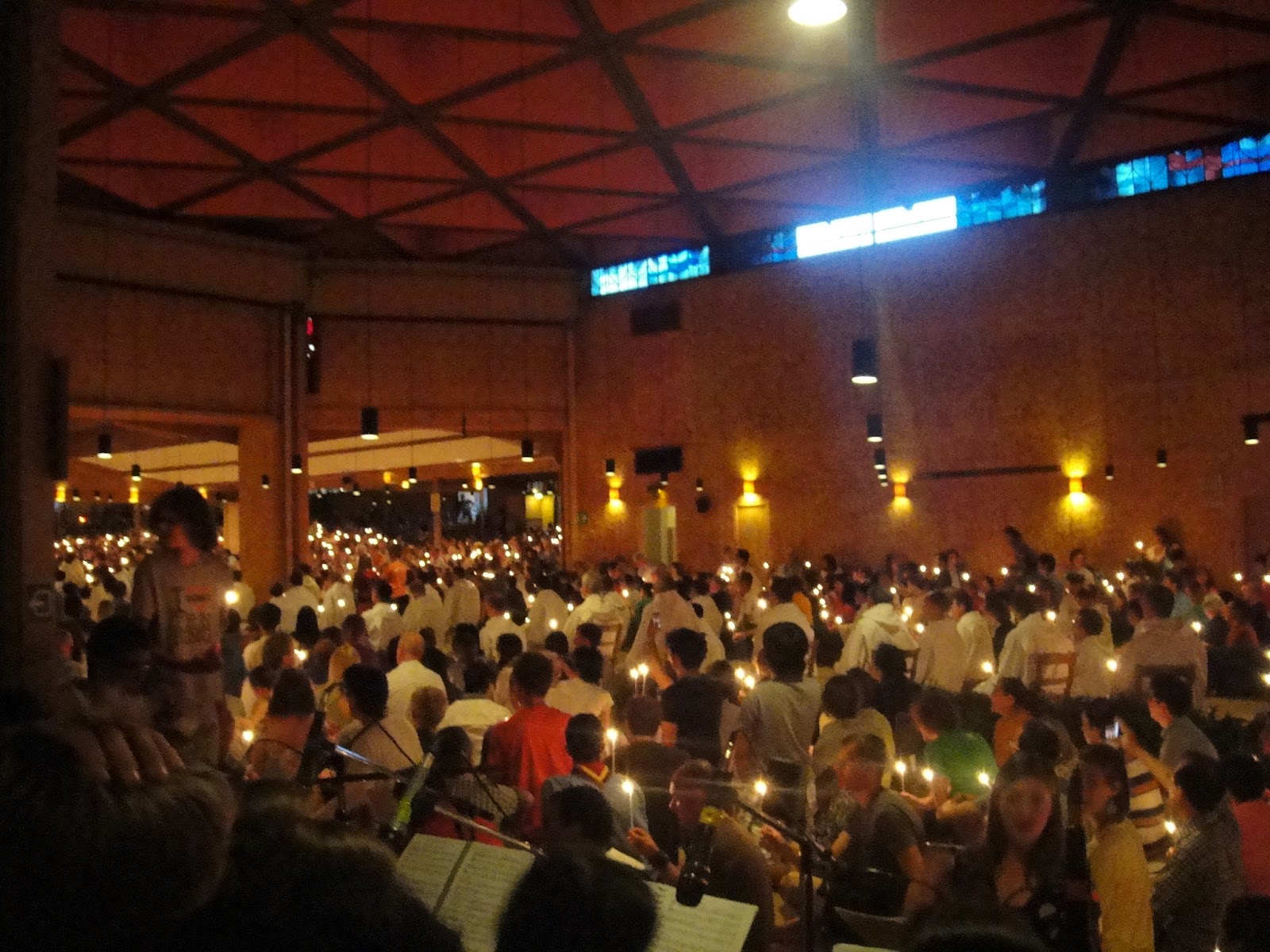 |
| Lighting candles during evening prayer |

 | |
| The village of Taize |
Taize really is in the middle of nowhere. From Paris I took a high-speed train that dropped me off in the pouring rain at a tiny country station surrounded by other twenty-something Europeans with backpacks who all seemed to be waiting for the same bus as me. A thirty minute bus ride brought us to the Taize community, where we were immediately hustled into the church for evening prayer. About five thousand people crammed into the church, a large open space with no chairs or pews. People of all ages sat or knelt on the floor.
Later that evening the newcomers were given an introduction and led to our accommodations- campsites for those who had brought tents and barracks for the tentless like me. We were given work assignments (I joined the choir) and locations for morning Bible studies.
 |
| Lessons in minimalism- meals were less than stellar, but we had fun eating on benches together. |
 |
| Church at a nearby village |
 |
| Mealtime queues provide an excellent opportunity to make new friends. |
I spent my afternoons having long conversations with new friends, or walking around the countryside to the nearby villages. The community includes a forested area with a lake, where people go to walk, sit and pray, or read. Taize is a popular European youth group destination, so the place was packed with teenagers, many of whom were eager to talk to me when they learned I'm from the United States. Of the five thousand at Taize the week I was there, there were about 15 Americans, so we were a bit of a novelty.
 |
| The surrounding landscape reminds me somewhat of Missouri- no wonder the French settled around St. Louis! |
Newly refreshed from Taize, I set my sights on the Dalmatian coast of Croatia for the next ten days of my vacation. But that is a story for another time. Cheers for now...
Thursday, August 30, 2012
challenges of teaching
Wow, it has been so long since I've updated my blog that I'm sure it looked abandoned. The reason, quite simply, was that I had run out of things to write about, or at least things that I could put a positive spin on.
Life got a bit hectic in May when one of my British coworkers decided that he couldn't stomach life in Ankara, but eschewed resignation for the easier method of moving out of his school-owned apartment in the middle of the night and never showing his face again. Other teachers, including myself, were forced to take on lots of extra work to cover the classes he left behind. This tactic, sadly, is far from abnormal in the world of English teaching, and is part of a sad cycle. In many parts of the world, teaching English is sort of a backpacker job, seasonal work that you can pick up to make some cash while traveling. Schools invite this mentality by hiring any white face with a passport from an English-speaking country, with the misguided assumption that if you can speak English, you can teach it.
Meanwhile, these unqualified persons get into a classroom where students eager to become proficient in English start asking questions like, "What's the difference between 'a lot' and 'much'?" and then realize that their knowledge of English is so innate that they have no ability to explain it to others. For example, the words "right," "correct," and "true" in Turkish are all covered by the same word (doğru) and so it's common for a student to say, for instance, "Teacher, Americans eat hamburgers for every meal. Is it true?" The teacher will then reply, "Of course it is not true!" The student is asking for feedback on his grammar, while the teacher is refuting the stereotype expressed in the sentence. Try explaining to the student the difference in meaning between these words, especially for a new teacher with know knowledge of the Turkish language and why this particular distinction is incomprehensible to a native Turkish speaker. Yep, it takes a bit of effort, and a lot of backpackers find themselves overwhelmed in a pre-intermediate classroom where the students know only basic vocabulary and can't follow regular English.
In addition, some of these hippie backpackers find themselves unable to cope with such professional requirements as showing up on time to class, preparing for lessons, wearing pants without holes, and grading homework. Eventually, some of the less competent individuals decide to remedy their situation by escaping. The schools are left in a lurch, and develop an attitude that foreign English teachers are a crowd of shiftless bums who cannot be trusted with any sort of responsibility.
This justifiable suspicion makes life more difficult for those of us who take our jobs seriously. Schools are reluctant to go through the hassle of a work permit for someone who might take flight mid-semester, to say nothing of making other investments such as professional development or even basics like allowing access to the office photocopier. Foreign teachers are watched closely, and you get the impression that the administration fears you won't do your job if not hounded about it constantly.
With schools treating teachers this way, those of us leaning toward the more professional side are easily frustrated with the system. I would love nothing more than to be at a school where I could stay for a long time and get involved in helping the school to develop, to collaborate with other teachers, to organize outside activities for students looking for further opportunities to improve their English. But instead I notice that foreign teachers become inward-focused and defensive, avoiding the office as much as possible and never trusting anyone. "They just want to screw you over," a coworker advised me on the first day. "Make sure you get everything they promised in the contract, and don't do anything for them unless they're paying you for it!" Goodhearted teachers quickly lose hope and become cynical. They're quick to distrust schools, and when negotiation fails, they hop on a midnight flight back home without so much as a note to explain their disappearance. And the cycle begins again.
In such an environment, my daily struggle is to look past whatever the job is doing and focus on the students. Regardless of the administration, these good people are paying a lot of money to be in my classes and deserve to have the best lessons that I can provide them.
Working in a school that opens classes on-demand, whatever levels and courses have the number of students, exhausts the teachers. I find myself teaching the same lessons over and over again, but try to use the opportunity to go back and improve them each time. It's a call to constant humility, realizing that in a private school the will of the students triumphs over all and that I can never make everyone happy. It's an exercise in turning the other cheek, recognizing that sometimes a school's mistreatment of me is due to hurt from past teachers, and using my position to do the best job possible, hoping that my diligence can build a small amount of trust. It's a daily challenge to overcome the negativity that surrounds and desires to infest me, and to choose to be the ray of light rather than letting myself slip into cynicism. If any of these small acts makes a difference to my students or to my coworkers, then I'm not wearing myself out in vain.
Teaching English in Ankara is not an easy proposition for anyone, especially qualified teachers from Western countries who come bearing certain expectations for job contracts and work environments. But that's not to say it can't be rewarding. It is, if for no other reason than that once in a while you really help a student, and before you know it that person is off in Germany or Russia, sending you emails in ecstasy that they can be part of the international community and connect with other people thanks to their English lessons. That is what makes it worth it.
But I can only say this with certainty after some distance from a long, hectic summer. To escape, I spent three weeks in France and Croatia, an adventure which I plan to blog about before long. Stay tuned...
Life got a bit hectic in May when one of my British coworkers decided that he couldn't stomach life in Ankara, but eschewed resignation for the easier method of moving out of his school-owned apartment in the middle of the night and never showing his face again. Other teachers, including myself, were forced to take on lots of extra work to cover the classes he left behind. This tactic, sadly, is far from abnormal in the world of English teaching, and is part of a sad cycle. In many parts of the world, teaching English is sort of a backpacker job, seasonal work that you can pick up to make some cash while traveling. Schools invite this mentality by hiring any white face with a passport from an English-speaking country, with the misguided assumption that if you can speak English, you can teach it.
Meanwhile, these unqualified persons get into a classroom where students eager to become proficient in English start asking questions like, "What's the difference between 'a lot' and 'much'?" and then realize that their knowledge of English is so innate that they have no ability to explain it to others. For example, the words "right," "correct," and "true" in Turkish are all covered by the same word (doğru) and so it's common for a student to say, for instance, "Teacher, Americans eat hamburgers for every meal. Is it true?" The teacher will then reply, "Of course it is not true!" The student is asking for feedback on his grammar, while the teacher is refuting the stereotype expressed in the sentence. Try explaining to the student the difference in meaning between these words, especially for a new teacher with know knowledge of the Turkish language and why this particular distinction is incomprehensible to a native Turkish speaker. Yep, it takes a bit of effort, and a lot of backpackers find themselves overwhelmed in a pre-intermediate classroom where the students know only basic vocabulary and can't follow regular English.
In addition, some of these hippie backpackers find themselves unable to cope with such professional requirements as showing up on time to class, preparing for lessons, wearing pants without holes, and grading homework. Eventually, some of the less competent individuals decide to remedy their situation by escaping. The schools are left in a lurch, and develop an attitude that foreign English teachers are a crowd of shiftless bums who cannot be trusted with any sort of responsibility.
This justifiable suspicion makes life more difficult for those of us who take our jobs seriously. Schools are reluctant to go through the hassle of a work permit for someone who might take flight mid-semester, to say nothing of making other investments such as professional development or even basics like allowing access to the office photocopier. Foreign teachers are watched closely, and you get the impression that the administration fears you won't do your job if not hounded about it constantly.
With schools treating teachers this way, those of us leaning toward the more professional side are easily frustrated with the system. I would love nothing more than to be at a school where I could stay for a long time and get involved in helping the school to develop, to collaborate with other teachers, to organize outside activities for students looking for further opportunities to improve their English. But instead I notice that foreign teachers become inward-focused and defensive, avoiding the office as much as possible and never trusting anyone. "They just want to screw you over," a coworker advised me on the first day. "Make sure you get everything they promised in the contract, and don't do anything for them unless they're paying you for it!" Goodhearted teachers quickly lose hope and become cynical. They're quick to distrust schools, and when negotiation fails, they hop on a midnight flight back home without so much as a note to explain their disappearance. And the cycle begins again.
In such an environment, my daily struggle is to look past whatever the job is doing and focus on the students. Regardless of the administration, these good people are paying a lot of money to be in my classes and deserve to have the best lessons that I can provide them.
Working in a school that opens classes on-demand, whatever levels and courses have the number of students, exhausts the teachers. I find myself teaching the same lessons over and over again, but try to use the opportunity to go back and improve them each time. It's a call to constant humility, realizing that in a private school the will of the students triumphs over all and that I can never make everyone happy. It's an exercise in turning the other cheek, recognizing that sometimes a school's mistreatment of me is due to hurt from past teachers, and using my position to do the best job possible, hoping that my diligence can build a small amount of trust. It's a daily challenge to overcome the negativity that surrounds and desires to infest me, and to choose to be the ray of light rather than letting myself slip into cynicism. If any of these small acts makes a difference to my students or to my coworkers, then I'm not wearing myself out in vain.
Teaching English in Ankara is not an easy proposition for anyone, especially qualified teachers from Western countries who come bearing certain expectations for job contracts and work environments. But that's not to say it can't be rewarding. It is, if for no other reason than that once in a while you really help a student, and before you know it that person is off in Germany or Russia, sending you emails in ecstasy that they can be part of the international community and connect with other people thanks to their English lessons. That is what makes it worth it.
But I can only say this with certainty after some distance from a long, hectic summer. To escape, I spent three weeks in France and Croatia, an adventure which I plan to blog about before long. Stay tuned...
Subscribe to:
Posts (Atom)